
Before 1700 - The Kansas Indians live at the meeting place of the Kansas and Missouri rivers. They speak a Siouan language and number about 1,600. They live in pole-frame lodges covered with bark, cultivate corn, pumpkins, beans and melons, and hunt buffalo twice a year. They also hunt beaver, otter and deer.
Early 1700s - French and other explorers ascend the Missouri River, hoping to trade with New Mexico, find precious metals and exchange goods with the natives.
1724 - French officer Etienne Veniard de Bourgmont passes the area on his way to visit the grand village of the Kansas Indians.
1804 - Lewis and Clark and their Corps of Discovery stops "at the upper point of the mouth of the river Kanzas" on June 26th, remaining for 3 days.
1806 - The Lewis and Clark expedition climbs the bluffs on September 15th on its way back to St. Louis. The men shoot an elk and pick custard apples.
1820s - Area Indians have left the region as the result of a treaty.
1821 - Beaver-felt hats are all the rage in Europe, commanding a handsome price. 21-year-old Francois Gesseau Chouteau, a French fur trader, his teenage bride Bereniece, and several other employees of the American Fur Company, establish a trading post. The place is called Kawsmouth. Chouteau writes to his uncle describing the perils of life at "Riviere des Kans." By the late 1820s, Chouteau has set up his headquarters there. The area becomes known as Chouteau's Landing.
Many of the hardy French Canadian and Creole trappers have native wives--Flathead, Cree, Gros Ventre, Kickapoo, and Sioux. Their mixed-blood children will be called metis, a people "in between."
Although never more than the home of a few dozen families, the French settlement at Kawsmouth is the center of an immense trade.
1823 - German duke, Paul Wilhelm, visits Kawsmouth. He finds 18-year-old Jean Baptiste Charbonneau, the son of Lewis and Clark's guide, Sacajawea, living there.
1825 - Cyprien and Frederick have both joined their brother Francois. Together they establish satellite trading posts up the Kansas River.
1826 - The town suffers in a devastating flood. The Chouteau's post and home are flooded, forcing them to move to higher ground. The new house is built on the river bluff.
1827 - James Hyatt McGee, his wife, and about a dozen children bring the first slaves to western Missouri.
1828 - After the Osage tribe cedes rights to the future Jackson County, U.S. pioneers begin pouring in. A land office opens and soon Anglo names soon overshadow the French in the plat books.
James McGee buys 320 acres near Chouteau's warehouse. In 10 years his holdings will have tripled.
1830 - The Indian Removal Act brings the Shawnees, the Delawares, and the Wyandots to the area. The Miamis, the Ottawas, the Kickapoos, the Potawatomis, the Weas and Peorias, the Iowas and the Sacs and Foxes also show up. The "emigrant Indians" will bring with them enormous buying power.
Isaac McCoy, a Baptist missionary and surveyor, is hired by the secretary of war to survey a boundary for the Delaware Indians who are soon to immigrate to the new Indian territory west of Missouri. He takes 2 of his sons, Rice and John Calvin as well as 2 other white men as chain carriers and a black man as cook. Calvin will first meet Methodist minister Thomas Johnson at Frederick Chouteau's trading house.
Invited by a group of Shawnee, Virginian Thomas Johnson establishes a Methodist mission several miles inside Indian Territory. He will use slaves, to the dismay of the Quakers.
1831 - Another group of Shawnee request a Baptist missionary. Isaac McCoy, a Baptist missionary and surveyor, begins a mission with Johnston Lykins, his daughter Delilah's husband, near the edge of the ridge overlooking Turkey Creek.
Frenchman Gabriel Prudhomme is killed in a brawl, leaving a pregnant wife, 6 children, a riverfront farm fronting the natural rock landing (for which he had paid $340), and a ferryboat. James McGee has designs on the property.
1832 - New York writer Washington Irving, traveling with a party that includes Paul Liguest Chouteau and J.H.B. Latrobe, visits the Chouteau's house. He will later write A Tour on the Prairies, which will help solidify the romantic image of the West.
Many of the Delawares die after drinking so much liquor.
Adeline Prudhomme is born. She will grow up to marry Milton J. Payne, Kansas City's third mayor.
1833 - Priest Benedict Roux arrives at Kawsmouth. The Chouteaus support his efforts to build a church.
With an eye on the Indian annuities and the Santa Fe traders on their way from Independence, college-educated surveyor John Calvin McCoy returns to Jackson County and acquires land near his father Isaac's house. He goes into business with J.P. Hickman and J.H. Flourney.
A natural rock ledge hugs the water's edge and makes a small riverfront area. Isaac and Calvin McCoy own a flat-bottomed ferry that uses the ledge for a dock.
1834 - Father Roux's log church is built--the town's first--with funds from the extended Chouteau family. Its name is St. Francis Regis but most people call it "Chouteau's church." Roux will run afoul of Chouteau's wife Berenice when he preaches against the popular weekly dances the French community holds.
The steamboat John Hancock arrives at the rock ledge landing with goods for Calvin McCoy's store. Then McCoy transports the goods 4 miles south to his store.
Calvin McCoy purchases land from Dr. Johnston Lykins and founds the town of West Port on one of the roads running southwest from Independence. He has the help of a black man named Tom who is a slave. A post office is established at West Port with McCoy as postmaster. He has trouble inducing anyone to move to his town, however. Between the visits of customers--business is slow--he and Tom have time to clear away the dense brush and vines from the land. A road is cut to the new town from the Chouteau warehouse on the Missouri River.
1835 - John Calvin McCoy files a plat for a 9-square block which is a portal to the western wilderness. He and 13 other men buy 271 acres which hold a natural levee and boat landing. He calls it "Westport Landing." It is 4 miles inland from Chouteau's Landing on the river, and shortens the land route that goods have to travel from the river to Westport outfitter's stations. Independence, 10 miles to the east, is the main outfitting center.
1837 - The Society of Friends (Quakers) begins its own mission.
James McGee has accumulated 1,000 acres in Jackson County and lusts after the Prudhomme property.
An order of the court puts the Prudhomme property up for sale. It is duly advertised in St. Louis and Liberty newspapers: "One of the best Steamboat Landings on the River...."
1838 - McGee secures the role of auctioneer, selling the Prudhomme land to a stranger in town, Abraham Fonda. It's July 7th. An immediate uproar ensues with McGee accused of collusion with Fonda and paltry proceeds for the Prudhomme heirs. The courts set the sale aside and another sale is ordered for November 14th. A group of 14 investors under the leadership of the wealthy St. Louis fur trader William Sublette, and calling itself the Town of Kansas Company, puts in the successful bid of $4,220 (Fonda's bid had been $1,8000). McCoy is one of the other enterprising capitalists. Fonda is also one of the partners--it's his idea to make a town, his heart set on naming it "Port Fonda." But the majority of the other proprietors don't like him, so they refuse to allow it. "Kawsmouth" is considered and rejected along with "Rabbitville" and "Possum-trot." They call it "Town of Kansas (or Kanzas)" because no one can think of anything better.
Debt-ridden John Sutter slinks out of Westport on a pony, leaving his debts behind. He rides west.
Francois Chouteau dies and is buried in St. Louis. He leaves Bereniece and 8 children. Madame Chouteau will live another 50 years, outliving all of her children and most of her friends.
1839 - Johnson moves his mission close to the Missouri border, expanding his influence to an area of 2,240 acres.
1840s - Steamboat traffic on the Missouri increases. The settlement begins to grow as a river port. Calvin McCoy's rock landing and the town overtake Independence as the principal outfitting point for the Santa Fe trade.
Dutch immigrant Dr. Benoist Troost arrives early in the decade with his wife.
The Wyandot tribe owns and operates a ferry across the Kansas (Kaw) River. They found the area as a town in 1843.
1842 - A national depression hits Missouri hard. Prices plummet and foreclosures and bankruptcies rise.
1843 - Kentucky farmer Richard Wornall buys a 500-acre farm from John C. McCoy. He will bring his wife and son John to the farm from Kentucky in the spring.
1844 - The great Missouri flood devastates the area. The Independence wharves are destroyed and Westport Landing gains most of the Santa Fe trade.
The Northern and Southern Methodists split, forming the Methodist Episcopal Church, North, and the Methodist Episcopal Church, South.
1846 - The worst of the depression passes in Missouri.
After lawsuits, financial difficulties, deaths and a holdup on the transfer of the deed and title to Prudhomme's property, the Town of Kansas finally gets going. Calvin McCoy surveys and prepares a plat with 318 lots, although the land is so hilly that the back sides of the lots curl up the hill behind the narrow river levee. The 7 proprietors left set aside a public square and dedicate land for a graveyard. Pierre Chouteau, son of the deceased Francois Chouteau, is their attorney. Dr. Troost buys 5 lots.
1849 - Asiatic cholera kills many citizens, including McCoy's wife and brother and William Gregory's wife, Elizabeth.
Troost and the uncle of his second wife, William Gilliss, build the town's first brick hotel, to cash in on California gold rush business. Gilliss House is situated near the river at the corner of Delaware and Wyandotte Streets.
1850 - On June 3rd, the Town of Kansas becomes a municipality when it is chartered by the county court. The 700 inhabitants, including William S. Gregory, who had successfully petitioned for this to be done are mostly interested in improving police services. Troost is a trustee.
1853 - The City of Kansas is chartered by special act of the General Assembly on February 22nd. Population is about 2,500.
63 vote in the election for mayor on April 18th. Grocer William S. Gregory wins over his opponent Dr. Benoist Troost by 9 votes. There is also a 6-member council. Gregory appoints a city treasurer, assessor, marshal, tax collector, and attorney. And he helps to write the city charter and signs Kansas City's first laws. It will be discovered later that he is ineligible to serve because of residency requirements, so Council President Dr. Johnston Lykins fills out Gregory's term, while Gregory continues as an alderman.
1854 - Milton Payne establishes the Kansas City Enterprise newspaper.
Kersey Coates arrives in Kansas City.
32-year-old widower John Wornall marries Eliza Johnson, the daughter of Reverend Thomas Johnson.
1855 - The First Baptist Church is organized.
The levee begins to receive not only tons of merchandise bound for Santa Fe but settlers bound for Kansas.
1855-1857 - The Wyandots sell their property and white settlers take over, calling the place Wyandotte.
Ohio native and ardent free-state man Abelard Guthrie lays out a new free-state town across the river in Kansas. It has a long frontage on the Missouri River and a rocky shore that makes a good harbor. Guthrie names the place Quindaro after his wife, a Wyandot Indian. A 45-room hotel goes up. Warehouses are soon filled with merchandise bound for Kansas. Quindaro becomes a refuge for runaway and stolen slaves.
1856 - Father Bernard Donnelly brings 300 Irish laborers from Connaught County to work a brickyard on behalf of the Catholic Church, to cut roads through the bluffs and to help build the city's first Catholic cathedral.
The side-wheel steamboat Arabia leaves St. Louis on August 30th, carrying supplies, provisions, 400 barrels of Kentucky bourbon, one mule and 130 passengers for a trip up the Missouri River. It leaves Westport Landing on the way to Parkville on September 5th, hitting a snag that rips open her hull. She sinks within minutes in 15 feet of water. All the passengers escape, but the poor mule is tied below deck and goes down with the ship.
1857 - Van Horn, Kersey Coates, and ex-missionary Johnston Lykins concoct their own railroad company, the Kansas City, Galveston & Lake Superior. It only exists on paper and the Missouri legislators laugh when approving it. But the charter allows for the acquisition and grading for a spur from Harlem on the Missouri's north bank to the Hannibal & St. Joseph Railroad line at Cameron 54 miles away.
Dr. Lykins builds a palatial home downtown on the southeast corner of 12th and Broadway. This $20,000 showplace soon becomes a social and political focus in Kansas City.
1858 - Wyandotte is incorporated as a town.
John and Eliza Wornall build a stately farmhouse next to the main dirt road going west to Santa Fe.
1859 - Wyandotte is incorporated as a city.
The Wyandotte Constitution is framed in July. Under it, Kansas will be admitted as a state.
1860 - Walter L. Watkins builds a 3 and 1/2 story brick mill near Lawson.
Kansas City's population has swollen to about 5,000.
1861 - A Union candidate for mayor, Robert Van Horn, is elected in April. He goes to St. Louis to explain Kansas City's perilous situation to Union Brigadier General Nathaniel Lyon and powerful Missouri Republican Frank Blair. He comes home with a major's commission in the improvised Enlisted Missouri Militia and a plan to keep the city out of Confederate hands. Kersey Coates joins Van Horn's battalion.
The Civil War begins. It seriously damages the economy of the area. Many move away from the violence. The profitable river and overland trade dies.
In June all Confederate flags are pulled down all over town.
The U.S. Army builds Camp Union at 10th and Central streets over the summer. It has walls, a guardhouse, and a 12-pound howitzer.
1863 - 4 woman relatives of Southern guerrilla leaders die when their temporary prison on Grand south of 14th Street collapses. One is the sister of "Bloody Bill" Anderson. 8 days later, Lawrence is burned and about 150 people are killed. 4 days after that, Brigadier General Thomas Ewing issues his General Order No. 11 (painted by George Caleb Bingham), forcing all residents of Jackson, Cass, Bates, and parts of Vernon counties to leave their rural homes within 15 days if they cannot prove their loyalty to the Union to the satisfaction of Army authorities. John Calvin McCoy moves to Glasgow where he conducts his business as best he can.
Two-thirds of the population of the border counties is gone.
1864 - Mayor Van Horn musters 60-day volunteers into the militia. All Kansas City men, Northern or Southern, young or old, are asked to sign up.
1865 - On New Year's Day, guerrillas fire through the front door of 62-year-old Reverend Thomas Johnson's farmhouse. He dies and is buried in the cemetery of his Shawnee Methodist Mission and Manual School.
The Civil War ends. Business leaders realize that the future of the city depends on the railroad. A showdown between Leavenworth and Kansas City will determine Kansas City's future. Dealmaker Charles E. Kearney and Detroit's James F. Joy, a powerful railroad executive, join boosters Van Horn and John W. Reid working for The Bridge.
Kansas City population stands at 3,500. Union loyalists live west of Main Street while Southerners favor roads east.
1866 - Jesse James robs his first bank: Clay County Savings Bank in Liberty.
1868 - Kansas City is platted.
Saints Peter and Paul Catholic Church is built at Ninth and McGee streets.
Democrats launch The Kansas City Daily Times.
1869 - Kansas City has far fewer people than Leavenworth or St. Joseph and is barely keeping pace with Atchison. All 4 cities want that first span over the Missouri. The Bridge opens near the foot of Broadway to national fanfare on July 3rd--the first railroad bridge over the Missouri River. (Later it will be known as the Hannibal Bridge.) There's barbeque, of course, liquor, and fireworks. A poem read at the formal banquet goes like this: "The Bridge, it is finished / In all its ponderosity / Trains have dashed over it / With great impetuosity / And thousands today / Have seen this curiosity." It helps to make the city a link in the nation's transcontinental railroad system.
Many Leavenworth and St. Joseph merchants buy into KC's hype, are convinced that their cities have forever lost, and hightail it to Kansas City.
1870s - The city develops as a market for grain, a stockyard center, and a meat-packing and flour-milling center during the next 2 decades.
1870 - William Warner becomes mayor.
Kansas City's population has exploded to 32,000 people.
Thomas Speers is elected Town Marshall on the Democratic ticket.
Train service begins to Denver.
Suffragette Susan B. Anthony first visits Kansas City. She strikes up a friendship with civic leader Sarah Coates, "the one woman upon who rested the claim of leadership of our suffrage work in that city."
The Coates Opera House opens. Kansas City's first large theater, it soon becomes a hub for society.
1871 - Railroad men and others organize the Kansas City Stockyards. The West Bottoms becomes the feeding place for cattle found for Chicago.
1872 - Booming in commerce, population and politics in the years after the Civil War, Kansas City becomes the dominant city of the county. As land transactions and legal wrangles multiply, more county business must be handled in Kansas City. A new Jackson County Courthouse opens on January 10th. It is modeled in the French Second Empire style.
Kansas City is incorporated.
The Central (or Walnut Street) and First Baptist Churches reunite as the First Baptist Church.
43-acre rural cemetery, Elmwood Cemetery, is established as a private cemetery although there are already some graves that date back to 1840. Famous landscape architect George Kessler designs the park-like landscaping.
1874 - In 1874, the "Metropolitan Police Law" established Kansas City's police department. Missouri Governor Charles Hardin appointed George Caleb Bingham, a Missouri artist, W. M. McDearmon and H.J. Latshaw as the first Board of Police Commissioners. Bingham became the first President of the Board and led the Board in selecting Speers as the first Chief of Police, a post he held for 21 years.
As Chief, Speers' unique policy was to, whenever possible, proactively prevent crime. Rather than waiting, as most police departments of the time did, to respond and apprehend the suspect after a crime had occurred, Speers took a different approach. During Chief Speer's tenure as Chief, Kansas City, Missouri was situated on nearly all lines of the great railroads leading from the Atlantic to the Pacific, making it one of the great railway centers. By 1901, an average of 20,000 people would arrive and depart from the Union Depot every day aboard the one hundred thirty five passenger trains passing through the city. Thus, 7.3 million people would travel through the city every year aboard the trains. Naturally, many professional criminals passed through the city among the train passengers.
1876 - Jim Pendergast, originally from Ohio, comes to the West Bottoms from St. Joseph to work in the factories.
Dr. Lykins dies August 15th at age 76. His good friend George Bingham will marry Martha Lykins.
1878 - Martin Keck expands his father-in-law's (Henry Helmreich) brewery into Kansas City's first amusement park, the Tivoli Gardens.
The Times labels Kansas City a Modern Sodom. The population is close to 50,000. The 80 saloons in KC are 3 times as numerous as the number of churches, and 4 times the number of schools, colleges, libraries, and hospitals combined.
1879 - The city's first telephone directory is printed. It lists 58 telephones in Kansas City.
1880s - Octave Chanute returns to Kansas City. He publishes The Sewerage of Kansas City, which urges town builders to resist combining rainwater with "house refuse."
The Vaile Mansion is built in Independence during the early 1880s by U.S. mail contractor Harvey Merrick Vaile. The design is inspired by a large house in Normandy the Vailes had visited during a trip to Europe. The house, designed by Kansas City architect Asa B. Cross, is completed at a cost of $100,000. An 1882 article in The Kansas City Times says that it is "the most princely house and the most comfortable home in the entire west."
1880 - Population is 55,785.
Ex-president, Union general, and notorious drinker Ulysses S. Grant stays with Robert Van Horn in the summer while he considers starting a business in Kansas City.
1881 - The first time electricity is used indoors in Kansas City is in March at the G.Y. Smith & Co. dry goods store on Main Street. Within a year, this "splendid triumph" of science is extended to 13 stores in the same block.
Irish poet Oscar Wilde lectures on aesthetics at Coates Opera House on April 17th.
People are driven from their homes and workers from the meatpacking plants when Kansas City is inundated by the flood of 1881.
Jim Pendergast wins a racetrack bet, which he puts to use launching a saloon below the bluffs among the unpainted shanties. His saloon also serves as a working-class bank.
A tornado tears through downtown, killing 4 people.
Police Officer Fred Houghton died on December 2nd, by an accidental discharge of his partners revolver as they board a streetcar. It is the first loss of life by an officer of the City of Kansas. The name of the City will be changed to Kansas City in 1889.
A drunkard inside the White House Saloon guns down Officer Martin Hynes on December 31st. It is the City's first slaying of a police officer in the line of duty.
1884 - Rabbi Joseph Krauskopt forms the nonsectarian Poor Man's Free Labor Bureau to help find work for the poor of all creeds.
1885 - The students and staff of Park College assist in building Benjamin Banneker School for blacks in the community. The one-room brick building will serve the community until 1902 when a larger facility is constructed.
1886 - On the morning of May 11th, a tornado rips through the Missouri River railroad bridge and then blows the top of the Jackson County Courthouse. 15 children die inside Lathrop School and 10 other persons elsewhere in the city. Many county records are lost or ruined.
Kansas City's first major-league baseball team, the Cowboys, plays in the National League.
1887 - Martin City is established as a railroad stop called Tilden, and then renamed for himself by Edward Martin, one of the town's founders.
The Kansas City Exposition Building, inspired by London's Crystal Palace, opens in early October. It has multi-block fairgrounds, a racetrack and a baseball field, as well as a stunning roof containing 80,000 square feet of glass. It will have a spectacular but brief existence as the headquarters of Kansas City's annual agricultural exposition.
The first president to visit Kansas City while in office comes to town on October 12th as a part of a national tour. President Grover Cleveland and his new wife, Frances Folsom Cleveland, see the new Kansas City Exposition Building and the federal building before leaving for Memphis, Tennessee.
Kersey Coates, having stoked his fortunes by dealing in West Bottoms property where rail lines and livestock pens merge, dies a millionaire twice over. He is buried in the Elmwood Cemetery.
1888 - The Board of Trade building, designed by Chicago's Burnham & Root architectural firm, opens.
1889 - A new charter officially changes the city's name to Kansas City.
John C. McCoy dies at his home on Olive Street.
1890s - Talk of founding a university in Kansas City becomes an increasingly evident part of the city's sense of growth.
William Allen White writes for Van Horn's Journal.
1890 - Charles Dillon Stengel is born in Kansas City.
1892 - Voters in the West Bottoms elect Jim Pendergast their alderman. He will extend his influence to the raucous North End where he develops another saloon.
1893 - With attendance falling sharply amid the nationwide depression, the Kansas City Exposition Building closes.
1894 - Bennie Moten is born on November 13th.
1896 - Colonel Thomas H. Swope provides Kansas City with 1,334 acres for Swope Park, which is 4 miles from the city limits.
1897 - Westport becomes part of Kansas City.
1898 - Dr. Thomas C. Unthank establishes the all-black Douglass Hospital in Kansas City, Kansas.
1899 - The city's first convention hall, designed by Frederick E. Hill, opens to the music of John Philip Sousa's band. It came in at a cost of more than double the original estimates, but is debt-free thanks to the donations of its citizens.
The Heim brothers open Electric Park next to their brewery in the East Bottoms, boosting both beer sales and their streetcar business. It features a German biergarten, bathing facilities, boating, rides, concerts, and a 2,800-seat theater for vaudeville and light opera.
1900 - The Democrats choose Kansas City as the site of their national convention.
Fire destroys the Convention Hall on April 4th (as well as the neighboring Lathrop School and Second Presbyterian Church), just 3 months before the scheduled convention. The city promises the Democrats a hall, and it does it, building one of the world's largest indoor arenas. Workers are adding the final touches just as the first delegates arrive. The phrase "Kansas City Spirit" is coined--a motto of proven merit. Kansas Citians strut around town wearing badges on their shirts saying "I Live in Kansas City--Ask Me."
Population reaches 163,752.
28-year-old Thomas J. Pendergast, Jim's brother, is named superintendent of streets.
Jim Pendergast nominated 38 year-old James A. Reed, the former prosecuting attorney for mayor. In the 1900 election, Reed the future senator owed his victory to Pendergast.
By 1900 Pendergast controlled the mayors office, the street and fire departments and dominated the police force. Pendergast named 123 of the 173 police officers on the force.
Kansas City's $1 billion in bank clearings are among the 10 highest in the nation.
Kansas City celebrates the turn of the century at Convention Hall.
Cable cars and electric streetcars are carrying Kansas City's population southward, farther and farther from its river origins. Urban sprawl is setting in.
1901 - Kansas saloon smasher Carry Nation brings her crusade to Kansas City on April 15th, touring saloons and criticizing their managers. She refuses to disperse the crowd she had gathered on the street and is arrested. Freed the next day, the judge gives her until 6 p.m. to leave town.
The Kansas City Times is bought by William Rockhill Nelson, giving his afternoon Star a morning edition.
The Coates Opera House burns down.
1903 - Swollen by spring rains, the Kaw and Missouri Rivers spill into the West Bottoms, turning the Missouri River into an inland sea that reaches the bluffs on both sides of the state line. The second great Kansas City Flood makes more than 22,000 people homeless, destroys bridges, ruins the waterworks and shorts out telephone and telegraph lines. After the flood, the railroads drop the idea of building a new station in the West Bottoms.
Fresh out of college, builder Jesse Clyde Nichols sells houses for less than $1,000 in Kansas City, Kansas.
A killer streetcar mows down B.M. Blankenship, a clerk at the Jones Dry Goods Co.
Dr. Thomas C. Unthank establishes the all-black Lange Hospital in Kansas City.
1904 - Lyda Burton Conley leads the effort which saves the Huron Indian Cemetery from demolition. She lives in a shack on the site for 6 years while she studies law and becomes the first Native American woman lawyer in the country. Women's groups nationally pressure Congress into passing a bill prohibiting removal of the cemetery.
Standard Oil opens a refinery in tiny Sugar Creek. The prospect of cheap oil spurs industrial development in the Blue River valley.
Kansas City has only 5 beauty parlors.
1905 - Alexander M. Dockery, governor of Missouri, failed to appoint Pendergast candidates to the Police Board and Pendergast lost some of his influence. The Kansas City World reporter wrote: It is not extra-ordinary that Pendergast views with alarm a measure that proposes to put the quietus on the practice of doling out the positions in public service as rewards for political services rendered to party bosses. February 27, 1905.
1906 - Jesse Clyde Nichols buys a 10-acre tract of land in order to build a "plaza" like the marketplaces he loves in Spain in what woudl become the Country Club Plaza.
12 railroads settle on a site for a new railroad station. It will be built in the bed of the O.K. Creek, which runs south of downtown.
1907 - J.C. Nichols opens his first "shopping center" at 51st and Brookside. The trolley line runs near the buildings.
The Heim brothers open a new Electric Park at 46th Street and The Paseo, also conveniently located on their streetcar line. It costs 10¢ to enter "Kansas City's Coney Island," with its artificial lake, roller coaster, band concerts, and 100,000 electric light bulbs that outline the buildings and rides. It is a great place to go after work, and more than 8,000 people do every day. But the fountain with living statuary is its unique attraction. 9 scenes are usually presented during each evening's 15-minute performance.
1908 - A small band of religious zealots take on the entire Police Department. The cult's leader, James Sharp, who calls himself "Adam God," and his armed followers take exception to officers corralling their children for panhandling downtown. A riot ensues. Adam God flees but is found in a haystack in Johnson County and is sentenced to 25 years behind bars.
1909 - Architect Nelle E. Peters arrives in Kansas City. She will soon be designing single-family homes and apartment buildings.
Henry Ford selects Kansas City as the site of the auto industry's first assembly plant outside Detroit.
The ASB (Armour, Swift and Burlington) Bridge opens, the second to span the Missouri River at Kansas City.
Worried by congestion, seediness, and the danger of floods around Union Depot, the City Council votes to build a new railroad station and voters approve the idea.
The Kansas City Zoo opens.
Kansas City annexes more land. It now covers 60 square miles.
1910 - 18-year-old Joyce Clyde Hall comes from Norfolk, Nebraska, to sell postcards in the growing Kansas City area. His move is inspired by a roving cigar salesman's story of the Convention Hall rising from the ashes.
A Pendergast man, James A. Reed, elected to the U.S. Senate in 1910.
The fireproof Empress Theater opens in May and is considered on of the most modern vaudeville houses in the country.
Thomas J. Pendergast succeeds his brother Jim as First Ward Alderman.
Popular ex-president Theodore Roosevelt bounces into town. He rides horses and speaks at Convention Hall with some 20,000 admirers squeezed in, filling every seat and aisle.
Construction begins on Union Station. Design changes and labor problems will delay the construction process and it will take 4 years for the station to open.
The city's pioneering Board of Public Welfare gets to work, although Pendergast's operatives work to smash the board and keep the poor all to themselves. The board and its hefty staff of social workers put Kansas City on the cutting edge of progressive thought. But by the end of the decade, its good intentions will fall victim to machine politics. The board is a harbinger of the welfare state.
The J.C. Nichols Memorial Fountain is sculpted in Paris by Henri Greber.
1911 - Construction begins on the massive Union Station building. The building is designed in the beaux-arts architectural style popular in the United States and France in the late 1800s and early 1900s.
Jean Harlow is born on March 3rd at 3344 Olive Street.
Electric Park charges 10 cents for admission. It attracts 1 million people this year, or more than 8,000 a day.
Walt Disney moves from Marceline, Missouri, with his family to Kansas City.
The ASB Bridge is completed.
1912 - Kansas City has 55,000 telephones, 221 churches, 72 public schools, 2,100 acres of parks, 70 miles of boulevards, and 260 miles of "up-to-date" street railway. It also has 81 movie theate rs with an average weekly attendance of 449,064, almost twice the population of the city.
Mike Pendergast moved into the middle class 10th Ward. The Pendergast machine took the election in 1912.
Walter S. Dickey, a wealthy Kansas City manufacturer, builds a stone mansion in the Rockhill district.
1913 - Chief H.W. Hammil introduces motorcars to the Police Department, ending horse patrols.
1914 - Kansas City is designated a Federal Reserve District.
Pendergast wanted to control the Board of Police Commissioners and did so with the help of Democratic Governor Elliot W. Major.
Architect
Jarvis Hunt's Union
Station opens on October 30th. Union Station
is considered by many to be Kansas City's
grandest building. Just after midnight on
the morning of Nov. 1, the first train, the
Missouri-Kansas-Texas Flyer, arrives at Union Station. The station cost nearly $6 million
and was part of a $50 million investment by
KCTR that also included track additions, switching
towers, viaducts and bridges.
1915 - Independence's disastrous Music Hall block fire on February 11th is battled by 2 Kansas City fire departments.
Motor travel is so common that the Police Department has a motorcycle squad to catch speeders.
William Rockhill Nelson dies.
1916 - Robert Van Horn dies at 91.
1917 - A fire strikes the stockyards in the West Bottoms, killing 17,000 cattle and hogs and destroying half the structures in the yards. Damages are estimated at $1.7 million.
Rail traffic through Union Station peaks during WWI-with 79,368 trains passing through the Station, including 271 trains in one day.
The U.S. declares war on Germany on April 6th. A tented city with accommodations for 5,000 draftees springs up in Kansas City. The old Home Guard practices maneuvers in Swope Park and women volunteer to be Red Cross nurses in France.
High school graduate Ernest Hemingway comes from Oak Park, Illinois, to Kansas City, arriving on October 15th. He spends 6 months as a cub reporter for The Star, covering the police, General Hospital and Union Station, interviewing VIPs and lowlifes, and practicing "the best rules I ever learned for the business of writing." Years later he will point to the Kansas City Star stylebook--with its instruction on using short declarative sentences--as the guideline he had followed throughout his literary career.
1918 - Ernest Hemingway leaves The Star on April 30th, despite his doctor father's misgivings. The Red Cross is calling Americans to join its ambulance corps in Italy. He and fellow reporter Ted Brumback apply and are selected.
Streetcar
workers strike. Dynamite attacks on several
cars lead to the use of National Guardsmen
to protect passengers.
Bennie Moten is leading his own professional
ragtime trio.
1919 - Traffic is heavy enough in Kansas City that L.J. Smyth, director of the Safety Council, is experimenting with one-way streets at Linwood Boulevard and the Paseo. He projects that by 1921, 50,000 cars will pass the busy intersection daily.
1920s - T.J. Pendergast is the powerful political boss of Kansas City government. Corruption among Kansas City politicians is common. Business interests will have to contend with his machine for the next 30 years.
Pendergast had used the police in a previous election because democratic governors Gardner and Major had given him control of the Board of police Commissioners. The 1920 elections were run under deplorable conditions.
1920 - Kansas City continues to grow as a center of commerce and industry. Population reaches 324,410. The black population is 30,893--a 30.3% increase in 10 years. It has risen 55% in Kansas City, Kansas: 14,474.
Walt Disney joins the Kansas City Film Ad Company. He helps make cartoon advertisements to be shown in movie theaters.
1921 - Lumberman R.A. Long's one-week fund-raiser to raise $2 million to build the Liberty Memorial is begun by him with a $70,000 donation. When at the end of the week, the drive is short $70,000, he writes another check.
The Jackson County court under Pendergast rule was under attack for excessive spending and questionable contracting. Republican Governor Arthur M. Hyde promised to put an end to the Pendergast and Shannon controlled police department.
Mike Pendergast s son James Pendergast had served with Harry Truman in World War I. Truman was known in the county, and had relatives throughout the rural precincts. He was a Baptist, a Legionnaire and a Mason. The Pendergast machine supported Truman in 1921 in his election as county judge.
All
five World War I allied commanders, including
General John J. Pershing, arrive by train
at Union Station and meet together for groundbreaking
ceremonies for the Liberty Memorial. Located
across the street from Union Station, the
Liberty Memorial is a monument dedicated to
the men and women who served and died in World
War I. More than 100,000 people attend. The
memorial was dedicated in 1926.
1922 - Construction
begins on Country
Club Plaza. The Mill Creek Building is
the first retail building to open.
J.C. Nichols begins a new subdivision south of 65th Street, called Armour Hills. The houses are more moderately priced than his Mission Hills and Sunset Hill developments. Bungalows cost $8,500 and 2-storeys are $9,500. Deed restrictions, as in Nichols' other developments, forbid ownership or occupancy by blacks.
1923 - The Fairyland Amusement Park is built at 75th Street and Prospect Avenue.
A building permit is issued for Muehlebach Field.
The red brick National Guard Armory is built on Main between 36th and 37th. It has an indoor baseball diamond.
The "German church," Saints Peter and Paul Catholic Church, sits on valuable property. It is torn down to make way for "the march of business."
1924 - The cornerstone of the Liberty Memorial is laid.
The "First Colored World Series" of baseball is held in Kansas City beginning on October 20th.
1925 -Workmen attack the clay hills of the Old Town bluffs with a pressurized water hose. They work day and night for 3 months, applying 400 pounds of pressure and 3,200 gallons of water a minute until the bluffs melt away into the Missouri River.
1926 - Former President William Howard Taft says: "The sons and daughters of our republic should rejoice that there were persons of vision and courage and energy near the geographic center of the Union to give permanent material form to a nation's tribute in this great work of art." The finished Liberty Memorial is formally dedicated by President Calvin Coolidge--many important world and national leaders are dedication attendees.
1928 - Kansas City hosts the Republican National Convention that nominates Herbert Hoover for president. A new kind of journalist, Graham McNamee, a "broadcaster," is on the platform at Convention Hall. He reports over the radio, including local station WDAF.
1929 - The charter for the University of Kansas City is granted.
The stock market crashes on October 29th and the Great Depression begins. The local black vote will be transformed from 80% Republican to 70% Democrat from 1922 to 1932.
A few strings of Christmas lights are put up on the Country Club Plaza.
1930s - More than 20 important projects, financed by a $40 million public works program along with federal assistance, make the decade a period of unexpected growth. There is a new city hall, a flood-protection program for the Blue River, parks improvements, the Kansas City Power & Light building, a new Jackson County Courthouse, and a new Municipal Auditorium.
1930 - A city resident calls attention to the fact that no street has ever been named for Kansas City's first mayor, William Gregory. 71st Street is renamed in his honor.
1931 - Transcontinental and Western Air Inc. (T&WA) chooses centrally-located Kansas City for its headquarters in June. Site-selection advisor Charles Lindbergh casts the swing vote over Tulsa.
Declining help from Hoover's federal relief committee, the city hands shovels to 3,442 people late in the year and puts them to work on sewer projects.
1932 - Kansas City Police Returned to Home Rule.
Presiding judge of the Jackson County Court, Harry Truman, creates the first County Park Department.
State democrats turned to the Pendergast machine for leadership. Harry Truman made an unsuccessful run for Missouri governorship in 1932. William Igoe organized the trench workers in St. Louis for Pendergast s nominee, Francis Wilson. Wilson died suddenly.
Rabbi Samuel S. Mayerberg, head of the Temple B'nai Jehudah on East Linwood Boulevard, launches an anti-machine gun crusade--his car is sprayed with gunfire and he begins sleeping with a pistol. The National Youth Movement, meeting in secret, is also at work. But times are fragile and people are scared, but Kansas City is doing a lot better than other places.
1933 - After a 40-acre donation of land in the Rockhill district by philanthropist William Volker and a citywide drive for funds in the midst of the Depression, the University of Kansas City announces that classes will begin in October. A faculty of 17 is hired. 264 students enroll on October 2nd, surpassing the board's minimum goal of 125. The Walter S. Dickey mansion, purchased with funds from Volker, is prepared for classes. 2 years of class work are offered the first year.
Made possible by $14 million from the estates of publisher William Rockhill Nelson and Mary McAfee Atkins, the Nelson Gallery of Art and Atkins Museum opens on December 11th. "Whistler's Mother" is on loan from Paris. NBC Radio carries the ceremonies to a nationwide audience. It rates high praise in national-circulation magazines and newspapers, which exclaim over the opulence of the building, the beautiful landscaping, the outstanding art collection, and the state-of-the-art lighting and ventilation techniques.
Union Station Massacre - One of the most infamous dates in Kansas City history is the Union Station Massacre. Convicted mobster Frank Nash, under escort by a team of FBI agents and police officers was shot and killed outside the Station during a shootout. Four law enforcement officers were also killed. There are marks on the front of the building that for years were claimed as bullet holes from the shooting, but tests by Kansas City, Mo. police recently showed the marks could not have come from bullets. However, the myth and the mystery of the incident live on. There were various theories that other mobsters had committed the crime, but the only man ever charged was Adam Richetti who died in Missouri's gas chamber. As result of the massacre, Congress strengthened the power of the FBI.
Pendergast had Judge Harry Truman given the directorship of the Federal Re-employment program in Missouri. This gave Pendergast more control of the Federal programs. When the Federal Civil Works Administration went into effect in 1933, Pendergast had even more patronage to hand out.
1934 - Thugs roam the streets on March 27th, election day for the mayor and City Council. Reformers are working hard to beat machine candidates. 4 people are shot and killed in factional disputes during the bloody city elections: a poll worker, a sheriff's deputy, a hardware store owner, and a machine enforcer.
Tom Pendergast had a history of illegal voting practices from the time he took over the machine in 1910. In the 1934 election in Kansas City four people were killed. The police who were put under home rule in 1932 (the city administration) ignored the illegal voting activities.
The Star finally begins to take a hard look at how far some Democrats will go to maintain power.
Johnny Lazia, Kansas City underworld chief and Pendergast ally, is shot to death July 10th as he steps out of his chauffeur-driven car in front of his fashionable apartment near Armour Boulevard and Gillham Road. The names of his assailants will never be determined. His position was filled by his bodyguard, Charles Vincent "Charlie the Wop" Carrollo.
The Kansas City Monarchs draw so many fans to Sunday baseball games that black churches adjust their worship hours.
County Presiding Judge Harry Truman, with strong support from Tom Pendergast, wins a seat in the U.S. Senate.
The Kansas City Philharmonic finishes its first season.
92-year-old Annie Chambers finds religion. Moved to tears by a funeral sermon by Reverend David Bulkley, she deeds her old brothel to Bulkley's cause, the City Union Mission. Her house at Third and Wyandotte streets is converted into a women's shelter.
In its first year, attendance at the Nelson Gallery of Art and Atkins Museum totals about 315,000, an average of more than 1,000 visitors per day.
Mid-1930s - The Christmas lighting of Country Club Plaza is already a tradition.
1935 - Harry Truman is sworn in as a member of the U.S. Senate. Pendergast's parting words to him are, "Work hard, keep your mouth shut and answer your mail."
By mid-1935 Pendergast appeared invulnerable. He controlled Kansas City and Jackson County. He reigned supreme in the state capital and the entire Federal Work Relief program in Missouri was under his direction. His patronage organization had traded jobs and services for support at election time. He also managed to create an image of respectability around his political machine. The seamy side was fairly well hidden.
39-year-old bandleader and pioneering jazz artist Bennie Moten stays in Kansas City while his band travels to Denver to begin an engagement at the Rainbow Ballroom. He dies undergoing a tonsillectomy on April 2nd at Wheatley-Provident Hospital. Moving his head during the surgery, he suffers a sliced artery and bleeds to death on the operating table. His death merits only 4 paragraphs on page 10 of The Kansas City Star. Moten's death will force Count Basie to become his own bandleader. He and others Moten mentored will soon move east and find international stardom with the so-called "Kansas City sound."
Municipal airport is serving 60,000 travelers a year.
2,000 women apply for the first T&WA training course for air hostesses.
Thomas Hart Benton has become the most important muralist in the country. He returns to Kansas City to teach at the Kansas City Art Institute.
1936 - The thermometer hits 113 degrees F on August 14th.
Convention Hall is torn down to provide parking for the new Municipal Auditorium.
Artist Thomas Hart Benton's mural in the Missouri Capitol includes a devilish Kansas City: a "business meeting" for which Pendergast himself posed. Builder J.C. Nichols and banker William T. Kemper are also in the picture, as well as scantily-clad women dancing on a stage.
Franklin Roosevelt began deserting Pendergast once the extent of the wholesale vote fraud became evident in 1936. Federal District Attorney Milligan, who was appointed to dismante the corrupt Pendergast machine and prosecuted the corrupt Kansas City election workers was reappointed in 1938.
1937 - Governor Stark calls for a federal probe after securing approval from President Roosevelt.
1938 - TThe Christian Science Monitor calls Kansas "wilder open than any place outside Reno" and attacks its residents for being "astonishingly complacent about it all."
Late 1930's - Governor Guy Park was swamped with request to use the state police to bring law and order to Kansas City but refused to do so.
In a fight to control the Missouri Supreme Court, Pendergast endorsed Judge James V. Billings. Governor Lloyd Stark backed incumbent Judge James M. Douglas. Pendergast still controlled the Work Progress Administration. Stark controlled state patronage. Judge Douglas won.
Since the Governor could not succeed himself Lloyd Stark planned to run for the U. S. Senate against Harry Truman in 1940.
1939 - World War II begins. Kansas City serves as a center of the defense industry.
Pendergast is arraigned on federal charges of failing to pay income taxes on a 1937 bribe. He plead guilty and was sentenced to 15 months in federal prison. His friends in City Hall tumbled one by one including the leader of the gambling syndicate and local mafia chieftan Charley Carollo went to jail. City Manager Henry McElroy was also indicted. He died of a heart attack in Septermber 1939 before he could be prosecuted. Following McElroy's resignation, Mayor Bryce Smith's audit of the books finds the city millions in debt.
Missouri Attorney General Roy McKeltside made a serious effort at enforcing laws on illegal gambling and the sale of liquor in Kansas City. Governor Lloyd Stark tried to have the Kansas City police department returned to state control. This was accomplished in 1939. In Kansas City gambling and other forms of vice were being protected and criminals from other cities had been finding refuge in the city. The newly appointed police chief, Lear Reed found that corruption was general and 50 percent of the police force was dismissed.
1940 - A reform group wins control of city government. The Pendergast machine's 15-year domination of city government. John B. Gage is the new mayor. L.P. Cookingham is the new city manager. The downtown slot machines are trucked away. The jazz clubs lose their crowds.
Remington Arms Co. announces in the fall that it will build an ammunition plant on 3,200 acres east of Independence. The Lake City Ordnance Plant will be cranking out 200 million rounds of ammunition monthly within 3 years.
The census reports that Kansas City has not really grown in population in the last 10 years.
Harry Truman wins re-election to the Senate.
The
Army Air Corps picks the Fairfax district
of Kansas City, Kansas, for a bomber plant
to run by North American Aviation. Plans include
the employment of between 8,000 and 12,000
persons - eventually to increase to 26,000.
1941 - The Kansas City-Western Dental
College merges with the University of Kansas
City.
The news of Pearl Harbor reaches the city. Retired Rear Admiral Hayne Ellis volunteers to head the city's Department of Civilian Defense. His operations will be staffed by tens of thousands of volunteers.
1943 - War workers move to town in droves. The local Board of Realtors reports 99.8% of housing units full, even with 40,000 hometown soldiers off to war.
1945 - Pendergast dies.
With the death of Roosevelt in 1945 Harry Truman becomes President.
World War II ends.
1948 - Paseo Massacre - On Monday, September 20, 1948, two officers, Charles Neaves, 30, and Sandy Washington, 26, were dispatched to 1334 Paseo on a disturbance call. The two officers rseponded to find a drinking party in progress. They informed William Bell, who was participating, that he was in violation of the conditions of his Peace Bond and would have to accompany them to police headquarters. Bell fires on the officers and a gun battle ensues. Four officers die. Read more: Paseo Massacre
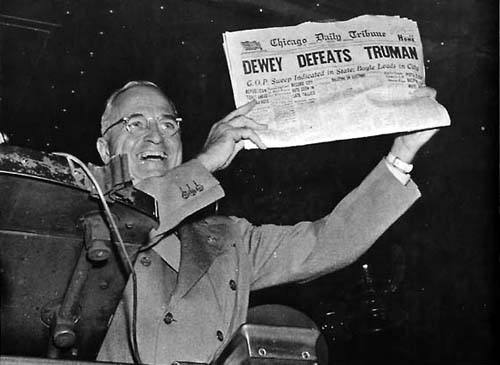
Flouting Republican landslide predictions, Harry Truman makes the experts look ridiculous. He travels over 31,000 miles by train in a “whistle-stop” campaign and makes more than 350 speeches. Truman is the first Democratic president to be elected without the "solid South." He wins 28 states and 303 electoral votes--and the Democrats also win control of Congress.
1949 - President Harry Truman, Vice President Alben Barkley and several Cabinet officers join 3,000 diners at a big black-tie dinner to honor the new Democratic Party Chairman. It is held on September 29th at Municipal Auditorium. William Boyle, the new party leader, is a Kansas Citian who had worked his way up in the Pendergast political organization.
1950 - Kansas stages a centennial celebration with pageants, parades.
The Kansas City metropolitan
area's population is 814,357 including Jackson
and Clay counties in Missouri and Wyandotte
and Johnson counties in Kansas.
Ewing Marion Kauffman begins his own pharmaceutical
company in his garage on Locust Street.
Joseph Binaggio and Charles Gargotta die in
gangland style assasinations.
1951 - The rain falls for 40 days
and the Great Flood in July inundates Armourdale
and the West Bottoms again. At least 5
people die. National Guard units take up positions
to discourage looting.
6-year-old Bobby Greenlease, son of millionaire car dealers Robert and Virginia Greenlease, is kidnapped and later killed before the kidnappers are able to collect the $600,000 ransom. Police will apprehend the kidnappers and find Bobby's body.
1954 - The American League approves the transfer of the Philadelphia Athletics baseball team to Kansas City on November 8th.
1957 - Kansas City's transit system stops using streetcars.
A tornado levels part of the Ruskin Heights suburb, killing 39 persons.
1959 - Wilbert Harrison's Kansas City hits the top of the charts.
1960 - The fountain sculpted by Henri Greber is installed at 47th Street and J.C. Nichols Parkway.
1962 - The Christmas lights on the Country Club Plaza number about 75,000.
1964 - Chicago millionaire insurance man, Charles O. Finley, owner of the Kansas City Athletics, brings the Beatles to Kansas City. He pays the group $150,000 for a 31-minute concert at Municipal Stadium. About 20,000 people attend the concert on September 17th--fewer than half the available seats are filled.
1967 - The Kansas City Chiefs lose to the Green Bay Packers 35 to 10 in the first Super Bowl, January 15th.
1970 - Population reaches 507,330.
1972 - Union Station receives federal designation as a protected structure and is placed on the National Register of Historic Places.
1973 - Richard Nixon appoints Clarence Kelley FBI chief. He will bring the bureau into the computer age.
1975 - Thomas Hart Benton dies in his studio chair on January 19th, just 3 months shy of his 86th birthday. His home and studio will be opened to the public as a museum.
1977 - Brush Creek ravages the Country Club Plaza after a savage thunderstorm dumps torrents of water on Kansas City on September 12th. 24 die and property owners suffer $94 million in damages.
1980 - The population stands at 448,033.
A heat wave of 17 straight days of temperatures above 100 degrees leads to the death of almost 200 people.
1981 - Two 120-foot-long walkways
above the lobby in the Hyatt Regency Hotel
tear loose from their suspension rods, dumping
65 tons of concrete, metal, glass and spectators
onto hundreds of people below during a dance
on July 17th. 111 persons die, including 18
pairs of husbands and wives. Of the 200 injured,
3 will die weeks or months later, pushing
the death toll to 114. KMB-AM radio newsman,
Walt Bodine, stays on the air all night, piecing
together events with on-air phone calls from
medical and emergency personnel, tea dance
attendees, witnesses, and reports. Blocks
away from the Hyatt, Kansas Citians stream
into the Community Blood Center and roll up
their sleeves. At one point, the donor line
stretches 3 blocks. The following Monday there
are 25 funerals.
Restaraunteer Arthur Bryant dies at 80.
1983 - Bobby Bell is the first Chief elected to the
Pro Football Hall of Fame.
An August power failure in Independence causes
a blackout across the city.
Martin Luther King, Jr. Hospital closes in
October.
1985 - The Kansas City Royals win
the World Series.
Mid 1980's - The downtown loop experiences an increase in new construction and the restoration of older neighborhoods.
1986 - Congress allocates money for a Brush Creek flood control project.
U.S.
District Judge Russell G. Clark orders a plan
to convert many Kansas City district schools
to magnet schools. He orders taxes increased
to pay for the change. Dozens of decaying
school buildings will be replaced or renovated
and new teachers hired.
The Nelson
Atkins Museum announces its acquisition
of a large collection of Henry Moore's sculptures.
1988 - Kansas City author Richard Rhodes wins the Pulitzer with the book, The Making of the Atomic Bomb.
In the worst loss to the city's fire department
since 1959, 6 firefighters die in an explosion
at a construction site in southeast Kansas
City on November 29th. 9 years later, 5 people
are convicted of setting the fires in the
truck trailers containing explosive ammonium
nitrate.
1989 - The last occupant moves out
of Union
Station. The mammoth building will sit,
deteriorating, for years.
1991 - In November, River Salvage opens the Arabia Steamboat Museum in the historic River Market area.
1992 - James Tate, a UMKC alumnus, wins a Pulitzer Prize for his poetry.
1993 - Heavy spring rains flood vast parts of the Midwest. In Kansas city, low-lying areas are vulnerable to flooding in the spring and summer.
1994 - Wilbert Harrison of Kansas City fame dies.
1995 - An expanded Kansas City Zoo opens to the public. It is now the 10th largest zoo in the nation.
The first phase of an $82 million flood control project from Roanoke Parkway to Troost is dedicated.
1996 - Robert Altman's movie, Kansas City, premieres.
1997 - Philanthropist Ewing Kaufman is inducted into the Hall of Great Missourians.
Clarence Kelley dies in Kansas City at the age of 85.
1988 - 11 people die in the flash flooding October 4th while the Chiefs play in the driving rain.
1999 - Kansas
City Police Officers Association formed representing Kansas City, Missouri
police officers, detectives, and sergeants.
The preamble of the KCPOA bylaws declares
one of the primary purposes of this organization
is to achieve collective bargaining. The organization was eventually renamed the Kansas City Fraternal Order of Police Lodge #99 and continues on in the effort of representing working police officers in Kansas City.
Science City opens in the
renovated Union
Station on November 10th. The $250-million-plus
restoration involved a unique public-private
partnership among area civic and political
leaders, the second-largest private fundraising
campaign in the region's history.
2000 - Kansas City Police Officers Association affiliates with the FOP and becomes the KCPOA - Missouri Fraternal Order of Police Lodge #99.
2001 - The U.S. Census confirms that Kansas City has reversed a 2-decade decline in population. The metropolitan area's black population has grown nearly 13% over the last decade. Jackson County now has a majority of minority residents: 56%, and that doesn't count the Hispanics.
2002 - An ice storm interrupts power to 387,000 area homes, damages trees, closes schools and businesses, knocks out streetlights, and causes runs in area stores on candles, sleeping bags, lamp oil, and generators. All the motel rooms are taken. 300 out-of-state utility crews from 12 states work 16-hour days to restore power. The cost of recovery after the storm is estimated at 20 million. A restored Liberty Memorial is rededicated on the Saturday of Memorial Day weekend. Its $90 million price tag was funded mostly by public money, including sales taxes.
The Kansas City Fraternal Order of Police announces that if officially represents more than 800 sworn members of the KCPD.
2003 - A major tornado outbreak occurred
across the Kansas City area during the late
afternoon and evening of May 4, 2003. Significant
tornado damage has been reported in Kansas
City, Kansas, as well in Gladstone and Parkville,
Missouri. This was the first major tornado
outbreak in the Kansas City area since May
4, 1977, when a large tornado struck the community
of Pleasant Hill, MO.
2020 - Kansas City deals with the world-wide Covid 19 Pandemic.
The 2020 census records experienced growth in Kansas City with the population increasing to 500,000.